€456,334 in credit. More than 500 farmers reached. Two cooperatives that proved smallholder farmers are ready for formal finance when the right foundations are in place. Access
On a cocoa farm, the work does not wait. Pods ripen on their own schedule. Weeds return after every rain. Branches need pruning, trees need spraying, and the harvest has to be gathered and carried out at the right moment. Each task costs money, and for many smallholder farmers in Ghana, that money is rarely there when the farm needs it most.
This is the quiet reality behind many cocoa communities. The challenge is not a lack of willingness to work. It is a lack of timely access to finance. When farmers cannot afford inputs or farm services, productivity slips. When their cooperatives lack strong financial systems or enough working capital, banks hesitate, and whole communities can remain stuck in a cycle of under investment.
Agriterra works to change that cycle from the inside, by helping farmer cooperatives become the kind of organisations financial institutions can confidently work with. Through cooperative advisory support, stronger financial management and carefully built partnerships, cooperatives that were once overlooked are becoming credible partners in formal finance.
Apartnership that grew from a pilot
One of the most significant partnerships has been with Pan-African Savings and Loans, part of the Ecobank Group. What began in 2024 as a pilot to close the financing gap for cocoa farmers has since grown into a scaled-up initiative, placing substantial capital directly into the hands of the farmers who grow the crop.
Two cooperatives show what that looks like in practice.
Akyemansa: from a financing gap to nearly €254,000 in farmer credit
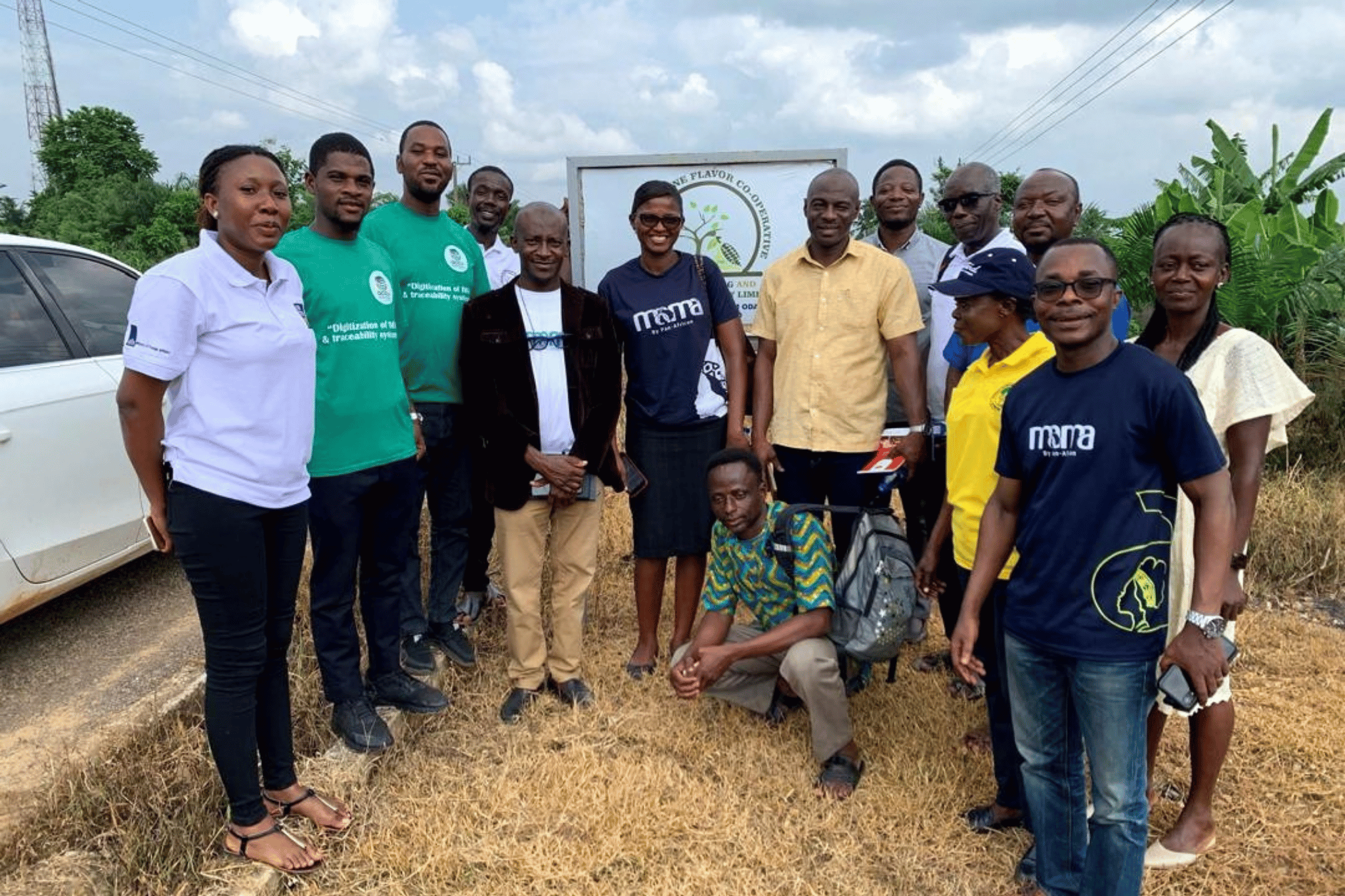
Akyemansa Fine Flavour Cocoa Farming and Marketing Society began as an association in 2018 and became a registered cooperative in 2021. When it joined Agriterra's client base in 2023, the gaps were clear: limited financial planning, weak book keeping and no long-term financing strategy. Farmers, meanwhile, struggled to afford the inputs and services their farms depended on.
The response started within the cooperative. With Agriterra's support, Akyemansa recruited a qualified accountant and introduced accounting software, giving its leaders a clearer view of the cooperative's finances. But better books alone could not put money into farmers' hands. Capital had to follow.
Working with Pan-African Savings and Loans, financial products were developed around the realities of cooperative farmers, and Akyemansa became the first cooperative ready to take part. The first round disbursed GHS 998,600 (about €56,846.19) to 165 farmers, who used it to pay for weeding, pruning and harvesting, and to buy agricultural chemicals.
Then came an honest look at what had worked and what had not. An evaluation found that more than six in ten borrowers had experienced delays in receiving inputs, and a similar share felt the loan was not enough to cover their farm needs. Those findings shaped what came next. The cooperative was supported to stock its farmer service centre with inputs, and a second, larger round followed. In 2025, GHS 2,403,200 (about €196,822.28) reached 306 members.
Together, the two rounds mobilised roughly €253,668.47 incredit for Akyemansa farmers. Some members borrowed in both rounds. This left the cooperative with a stronger financial system and a better-stocked service centre.
Baakoye:building the foundation before unlocking finance
The story of Baakoye Cocoa Cooperative Farmers and Marketing Union Limited carries a different lesson: finance follows preparedness.
Baakoye started in 2018 with four communities and 89 members. By 2025 it had grown into a union of 22 communities and 2,750 members, 1,222 of them women and 1,528 men. When its finances were assessed in 2023, weak financial management stood out as a major challenge. The union was also not yet ready to join the financing programme because it had no fully operational farmer service centre.
Rather than step around that gap, Baakoye chose to close it. The cooperative established its own service centre, and Agriterra supported it to stock the centre with agricultural inputs, bringing supplies and services closer to the communities that need them. Financial literacy support and direct engagement with Pan-African Savings and Loans helped members understand the products on offer and what repayment would ask of them.
On 14 August 2025, after a careful process of sensitisation, registration and verification with members, GHS 2,509,000 (about €202,665.596)was disbursed to 340 farmers. For them, it meant capital for inputs, tools and farm services at the point in the season when they are needed, not weeks later.
More thana loan
The story across both cooperatives is not simply about money moving from a lender to a farmer.
It is about farmers gaining the ability to invest in their farms when investment matters most. It is about cooperatives strengthening their financial systems so they can engage banks as capable partners. It is about farmer service centres becoming practical, local platforms where members can reach inputs and services. And it is about a shift in how smallholder farmers are seen: not as people who cannot be served by formal finance, but as economic actors who use credit responsibly when the right systems and support are in place.
Agriterra's role has reached well beyond introductions to a lender. By walking along side cooperatives through advisory support, financial management, financial literacy, service-centre development and follow-up after disbursement, it has helped create the conditions in which finance can actually reach farmers and be put to good use.
The numbers tell part of the story
- Total financing facilitated: €456,334.06 (GHS 5,910,800)
- Akyemansa, first round: €56,846.19
- Akyemansa, second round: €196,822.28
- Baakoye: €202,665.59
- Farmers reached: more than 500, across three financing rounds
Behind every figure is a farmer. A farmer who could pay for pruning instead of leaving the farm unattended. A farmer who could buy the right quantity of inputs. A farmer who could hire help to harvest when the cocoa was ready. A cooperative that could stock its service centre and serve its members better. And behind each of them, a family whose livelihood rises and falls with the health of that farm.
There is more ground to cover. Many cooperatives across Ghana and the wider region are on a similar path, strengthening their systems and getting ready to take their place at the table with financial institutions. Lenders, investors and development partners who want to see rural credit reach smallholder farmers have a ready set of farmer organisations to work with, and a model that has already shown it can scale from pilot to portfolio.
The real impact is not the funds that was disbursed. It is what that money makes possible in the hands of farmers.