For decades, cocoa has been the backbone of Ghana’s agricultural economy and the lifeline of many smallholder farmers. Yet the Asetenapa Cocoa Cooperative in Nankese, Eastern Region, recognised the risks of relying on one single crop. Price volatility, climate change and external shocks threatened the livelihoods of its members. To safeguard their future, the cooperative embraced a bold vision: diversify into cassava processing.
A vision for diversification
In 2023, through the Acting Now programme facilitated by Agriterra, Asetenapa began exploring cassava as a complementary enterprise. Cassava, a staple crop in Ghana, offered both food security and market opportunities through products such as gari.
The cooperative’s women’s council, already experienced in cassava processing, championed this idea. What they needed was organisational and technical support to transform their skills into a sustainable business. Agriterra stepped in to help build that bridge.
Building capacity and business plans
The Acting Now team conducted a needs assessment and trained lead farmers in sustainable cassava production using a train-the-trainer model. This knowledge spread across the membership and was reinforced by an extension officer, ensuring learning became part of daily practice.
By September 2024, Asetenapa, guided by Agriterra, had developed a comprehensive business plan for a gari processing enterprise led by the women’s council.
Investing in transformation
Turning plans into action required resources. With co-financing from Agriterra in late 2025, Asetenapa acquired cassava processing equipment including graters, crushers, roasting pans and sealing machines worth over €5,000, with the cooperative contributing 20 per cent.
To strengthen logistics and extension services, further investments were made in tricycles and a motorbike valued at €5,075.09, again with the cooperative playing its part.
Delivering impact
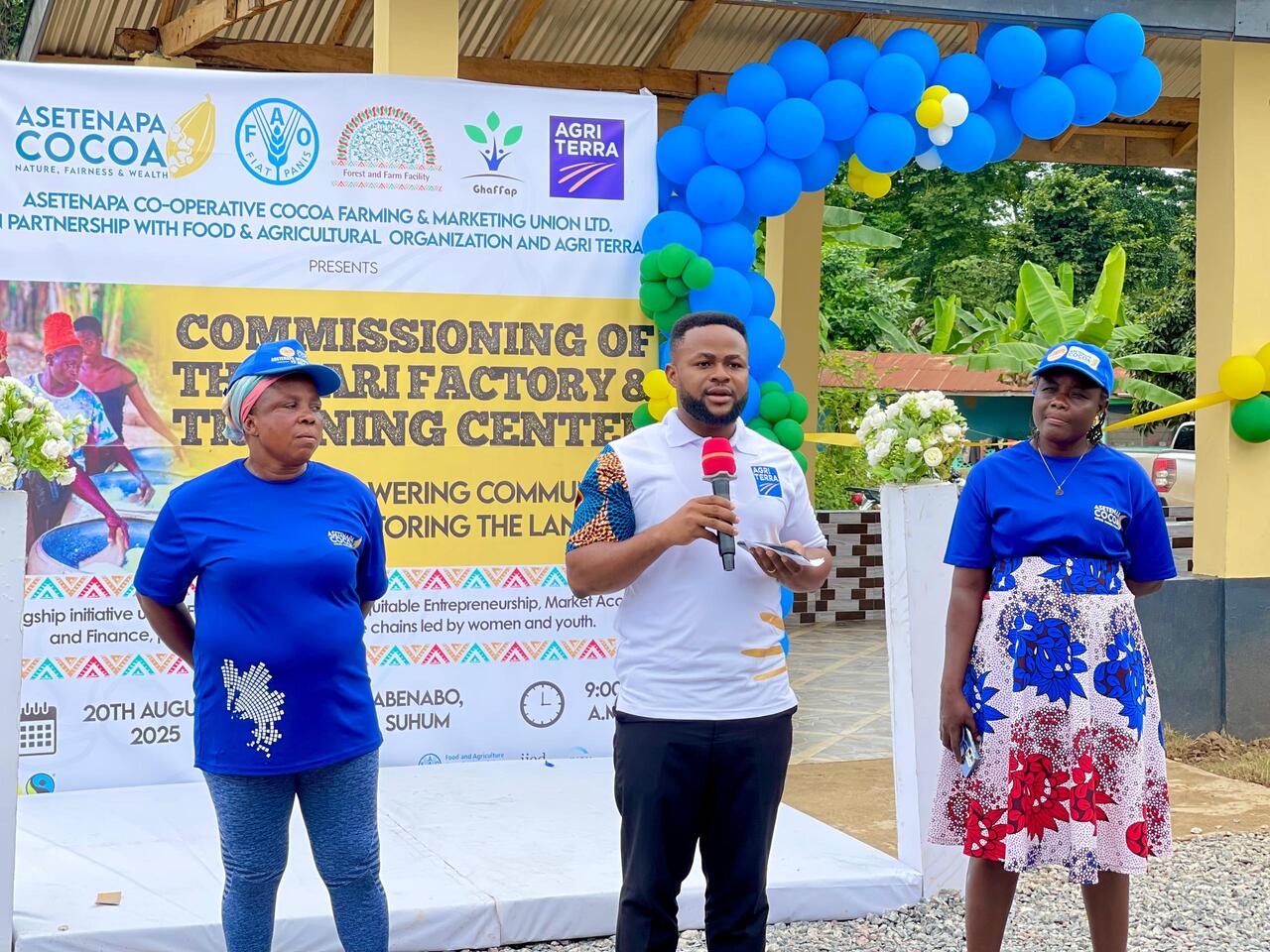
On 20 August 2025, Asetenapa proudly commissioned its new gari factory and training centre — a milestone in its diversification journey. The factory does more than produce gari. It creates jobs, secures year-round income and reduces dependence on cocoa.
For cooperative members, this means improved household food security, income stability and greater resilience against external shocks. For the wider community, it provides access to affordable, nutritious food products and showcases the potential of nutrition-sensitive value chains.
Cassava processing also strengthens household nutrition by producing vitamin-rich gari fortified with local staples such as beans, helping to combat micronutrient deficiencies common in cocoa-dependent areas.
Broader significance
The story of Asetenapa is more than one cooperative’s success. It is proof that with the right support, Ghanaian farmer organisations can diversify, empower women and youth, and enhance resilience.
By linking food production to processing and market access, Asetenapa now contributes directly to Ghana’s food and nutrition security goals, while aligning with Dutch priorities on sustainable agriculture, inclusive value chains and climate resilience.
Asetenapa’s journey shows that investing in farmer-led diversification is not only about economics. It is about securing livelihoods, improving nutrition and sowing the seeds of a sustainable food system for the future.
.jpg)